Residents, business community encouraged to comment on draft spatial plan for Cape Town CBD
07 April 2025
The City of Cape Town invites residents, the business community and all stakeholders to comment on the draft local spatial development framework (LSDF) for the Cape Town CBD. This framework encapsulates the City’s vision for the CBD’s future growth and will guide decisions about land use and development, density, the public realm including streets, and urban design. Once approved, it will also inform public investment in infrastructure to ensure that the CBD transitions into a more sustainable, equitable, inclusive, liveable and resilient space to the benefit of current and future generations of Capetonians.
The first draft LSDF was made available for public comment in September and October last year.
The comments received during this period have been used to further refine the LSDF, including the Implementation Plan. The latter consists of programmes, projects and actions to be implemented by various City departments with support from the private sector and other inter-governmental stakeholders in various priority precincts within the CBD.
A Mobility and Access Plan specifically designed for the CBD, is in its formative stage, and will be shared as an annexure to the draft LSDF for a first round of public comment.
‘Once approved, the LSDF will guide us towards the CBD of 2040, the City of Hope where land use and spatial planning facilitate sustainable economic growth and the investment needed to create more jobs. This must happen while we are investing public money to improve access to the formal economy and social opportunities. The provision of affordable housing opportunities is key, while we are also cementing the CBD’s future potential.
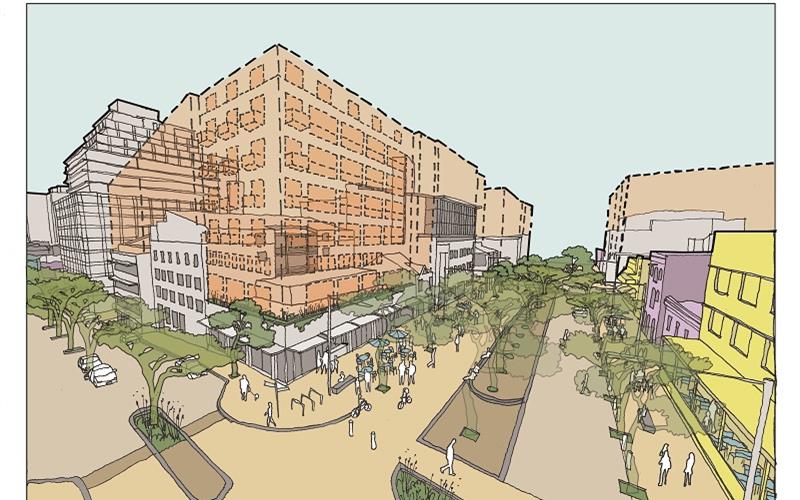
‘The LSDF intends to transform the CBD into a more people-centred environment with urban design interventions to improve mobility and access for pedestrians, efforts to optimise heritage areas, a public land programme to inform land release in support of affordable housing opportunities, and an appropriately scaled urban form and interface to encourage mixed-use intensification. With mixed use we mean development that accommodates multiple uses such as business, retail, and residential opportunities for existing and new buildings.
‘Thus, in short, we need the CBD to be accessible, safe, attractive, and inclusive. The LSDF must guide development decisions to accommodate the growth in the property market, facilitate mixed-use and residential intensification, while leveraging the character and traditional urban fabric opportunities.
‘There is no doubt that the CBD is key to Cape Town’s future resilience and economic health and that there is an opportunity to fully optimise the CBD’s existing characteristics such as its unique sense of place with the Atlantic ocean and Table Mountain, its diverse cultural heritage, and vibrancy. I encourage residents to comment on the draft LSDF and to also attend the online sessions where officials will give presentations and answer questions,’ said the City’s Deputy Mayor and Mayoral Committee Member for Spatial Planning and Environment, Alderman Eddie Andrews.
Study area
The study area is the core economic area of the CBD, bounded by Helen Suzman Drive/FW de Klerk Boulevard to the north; Nelson Mandela Drive and Sir Lowry Road to the east; Mill Street/Orange Street to the south; and Buitengracht Street to the west.
The study area is divided into eight precincts, each with its own characteristics, constraints, and opportunities namely:
• De Waterkant
• Convention District
• Mid-City
• Company Gardens
• East Foreshore
• Cape Town Station
• East City, and
• Lower Gardens
The draft LSDF provides development guidelines for each precinct in terms of its urban form, approach towards height management, and character assessment.
Implementation Plan
The draft LSDF proposes an implementation framework for priority precincts and a programme of action for City departments to implement over the short-; medium-; and long-term. This includes public investment priorities on public transport, roads, and non-motorised transport to improve mobility; upgrades to public squares and streetscapes; and proposed projects to ensure the CBD’s appeal as a tourist and investment destination, amongst others.
Some of the proposed City-led short-term projects are:
• Improving the public realm from the Cape Town station to Dock Road/V&A Waterfront with interventions along Long, Loop, and Bree Street and Buitengracht
• Transforming Harrington Square to improve the public realm
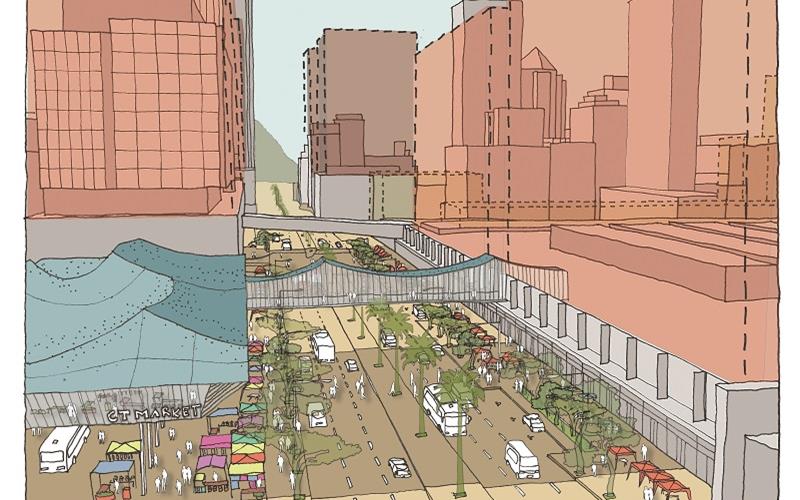
• Developing a concept vision for the Grand Parade, including uniform formal trading market structures; linkages to Darling and Hanover Streets, and the Castle; as well as a pedestrian link over Strand Street;
• Upgrading the outdoor gym at Kamp Street, opposite De Waal Park
• Upgrading of Jutland Park to include pathways and a park for dogs
• Upgrading of Long Street swimming pool
• Expanding the Chapel Street Clinic
Existing policies informed the draft LSDF
The draft LSDF is informed by existing policies, such as the Table Bay District Spatial Development Framework (DSDF) of 2023; the approved LSDFs for District Six and Bo-Kaap; newly approved policy for Designing Quality Places, the City’s Climate Change Strategy and action plan, and Tall Buildings Policy.
The Table Bay DSDF and Municipal Spatial Development Framework support higher residential densities and mixed-land use intensification for the CBD area. The draft LSDF proposes appropriate building heights taking into account the view of key landmarks such as Table Mountain and Signal Hill, public spaces, and the interface with heritage buildings, cultural resources, and residential areas.
 Context
It is estimated that the CBD will have to provide residential opportunities to an additional 50 000 people by 2040. This projected demand translates into a specific urban form that needs to be managed through spatial and land use policy and regulation
The CBD is attractive to business thanks to its unique setting and character that drives the land value. The LSDF intends to assist in land use regulatory improvements to facilitate development while providing guidelines to protect heritage resources. This includes height benefits in exchange for residential units and public realm improvements and investments
Access to and from the CBD from the rest of Cape Town is poor. Restoring passenger rail as the backbone of public transport is key
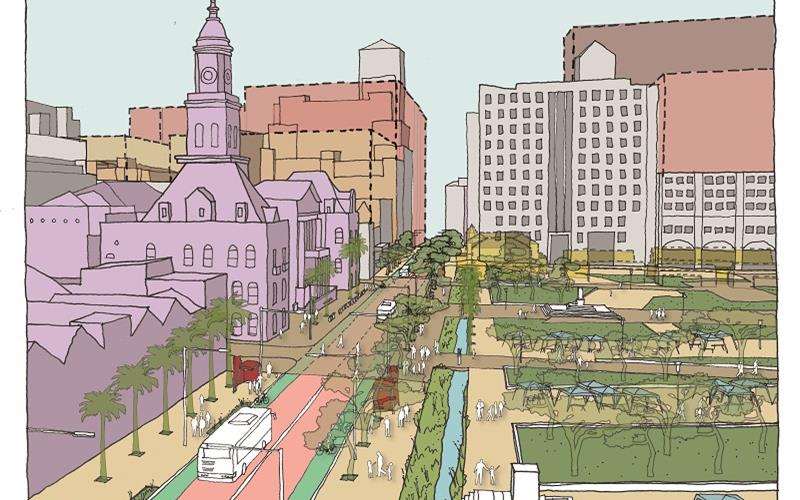
The CBD is still dominated by vehicles. Interventions are needed to create a more pedestrian-friendly environment and public spaces with greening to give workers and residents relief and escape from the urban environment
Private and public precinct management contribute to investor confidence in the CBD, and as more visitors are drawn to Cape Town, the demands on the public realm, public transport, precinct management services, as well as land use will increase
The draft LSDF elaborates on the spatial constraints and opportunities, upgrade of public open spaces and the creation of new green areas in the vicinity of the Foreshore, for example.
As for the public realm, the LSDF proposes a pedestrian-friendly CBD that links Table Mountain with the Atlantic ocean through key public spaces, each with their own identity, and more green recreation spaces; the upgrade of squares such as the Grand Parade, Civic Square, Riebeeck Square, Greenmarket Square, and Harrington Square, which is currently the focus of a feasibility study.
The LSDF looks into nodal character areas, or places which contribute to the unique sense of place and in some instances, include important heritage assets. In an effort to rationalise the heritage protection overlay zone, the LSDF identifies enclaves of existing historic building fabric to be retained and enhanced, and where detailed heritage management provisions are to be developed for inclusion in the Development Management Scheme.
The draft LSDF is available on the City’s website at: www.capetown.gov.za/haveyoursay
How to comment:
• Go online www.capetown.gov.za/haveyoursay
• Submit comments by 11 May 2025
• Attend the public information sessions
‘I encourage residents and property owners to be part of this process, to submit comments and attend the information sessions. It is in everybody’s interest to get involved and contribute to the discussion. Your input matters, and we will take this into account as we finalise the draft LSDF for Council’s approval once the public participation process has been concluded,’ said Alderman Andrews.
End
Published by:
City of Cape Town, Media Office